Learning from Netherlands
4 September, 2026
Giorgiana Zachia and Mick Wilson
Zoom
Participation is free. Booking required (Book here).
About
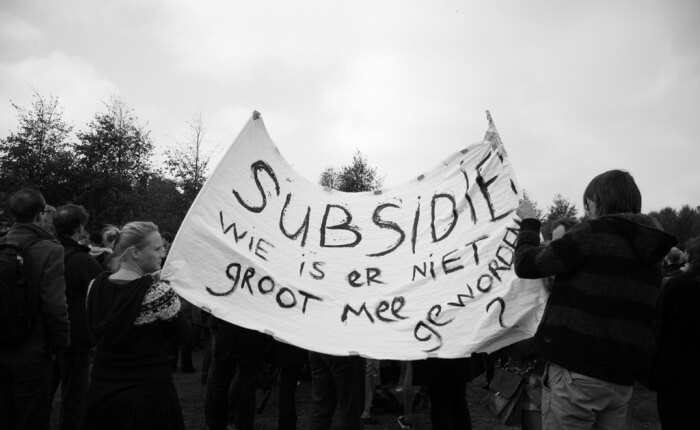
Over the past twenty years, the Netherlands has been described as undergoing a significant political shift to the right. Migration and national identity have moved to the centre of public debate, while positions once associated with the political margins have increasingly entered the mainstream and, more recently, government. At the same time, successive governments have reshaped the public sector around market-oriented principles, reducing public funding in some areas and placing greater emphasis on efficiency, self-sufficiency and measurable outcomes. Culture has been affected by both developments: increasingly framed as an economic sector as well as a public good, while institutions and artists have faced growing expectations to demonstrate their value and relevance.
During this period, the conditions for publicly funded culture have changed significantly. Following substantial cuts to public funding in the early 2010s, questions around cultural funding, artists’ working conditions and the sector’s reliance on public support became increasingly prominent in cultural policy debates. At the same time, expectations placed on institutions and artists have shifted, with greater emphasis on self-generated income, entrepreneurship and audience development. In parallel, new forms of organising have emerged, while questions of fair remuneration, diversity, inclusion, decolonisation and institutional autonomy have gained increasing importance. Over the past two decades, the Dutch cultural sector has thus undergone both economic and structural change, while also developing new ways of organising and articulating shared demands.
The seminar approaches these developments from several perspectives. Lara Khaldi, artistic director of de Appel in Amsterdam and a former member of the curatorial team of documenta fifteen, will reflect on the conditions facing art institutions and on how institutions can function as infrastructures for artistic practice. Falke Pisano, internationally renowned artist living and working in Rotterdam, will focus on artists’ own forms of organising, addressing working conditions, the production of value, and how artists can develop shared strategies for navigating uncertainty and risk rather than having to bear them individually.
Respondents:
Sara Edström, Konstnärernas Riksorganisation
Emmeli Persson, Bildkonst Sverige
About the series:
Jointly convened by the Public Art Agency Sweden and CAPIm the online public seminar series Artists’ Organising in Times of Upheaval considers countries where there are dramatic reversals and instabilities in national politics and the ways in which artists and artists’ organizations mobilize to influence the policy process and/or to secure the arm’s length principle. continues with Learning from Slovenia (4 December).