A Ground(ed) Elsewhere: Symposium
About
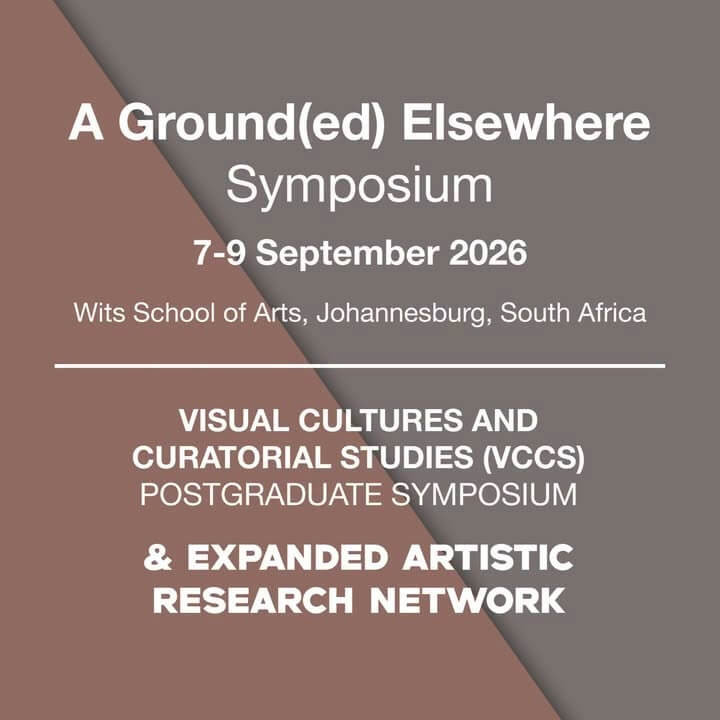
A Ground(ed) Elsewhere symposium on 7-9 September 2026 is a multidisciplinary programme developed with international and local partners (including colleagues from EARN and CAPIm.) It brings together postgraduate students registered in art history, visual cultures, and curatorial practices, as well as lecturers from Stellenbosch University, Rhodes University, Tshwane University of Technology, the Michaelis School of Arts at the University of Cape Town, and the Wits School of Arts at the University of the Witwatersrand. The Visual Cultures and Curatorial Studies (VCCS) Postgraduate Symposium fosters cross-university conversations guided by a desire to keep pace with emerging trends in creative and theoretical practices. The symposium was established in 2021 to enable students across different South African universities to learn from one another.
The Curatorial, Public and Visual Cultures department at the Wits School of Arts in Johannesburg is hosting the 2026 VCCS symposium. For 3 days, students and colleagues from various departments will present their ongoing research under this year’s theme, A Ground(ed) Elsewhere. There will also be Keynotes by invited thought leaders, including Dr Uhuru Phalafala, Anawana Haloba, and Professor kąrî’kąchä seid’ou.
The theme for the Johannesburg symposium A Ground(ed) Elsewhere, is partly drawing upon Uhuru Phalafala’s work on forms of being, knowing, aestheticising, and doing from the Southern African Black cosmological archives. Phalafala interrogates here(ness) and elsewhere(ness) as sites of imagination, memory, and knowledge inherited from indigenous cosmologies. Invariably threading the two concepts to forms of matriarchal knowledge “a counter-cartography from the Black cosmological archive, one which maps and generates alternative forms of ontologies, relationalities and epistemologies.” These ideas of groundedness, framed within a cosmology that rejects the ocularcentric hierarchising of coloniality, also link with the Livingston Perennial theme of “Sonic Solidarities” for the Zambia leg.
Extending beyond Southern Africa context, the keynote invitation to Professor kąrî’kąchä seid’ou at Kwame Nkrumah University of Technology and a founder of blaxTARLINES, represents an unprecedented regional intellectual mapping of curatorial pedagogy. Born out of a “condition for arts practice [that] suggests a new way of being,” Professor Seid’ou is often credited with establishing and enabling the platform blaxTARLINES KUMASI. In his role as the harbinger of socially responsive artistic and curatorial practices and pedagogies in Ghana, the invitation positions Professor Seid’ou as an important interlocutor for both events at Wits and LoCA, where he will deliver keynotes. The symposium will include various book launches, including CPaVC’s very own publication that maps the work of this department in curatorial pedagogies. There will also be networking events and a student exhibition in collaboration with the Goethe-Institut Johannesburg.
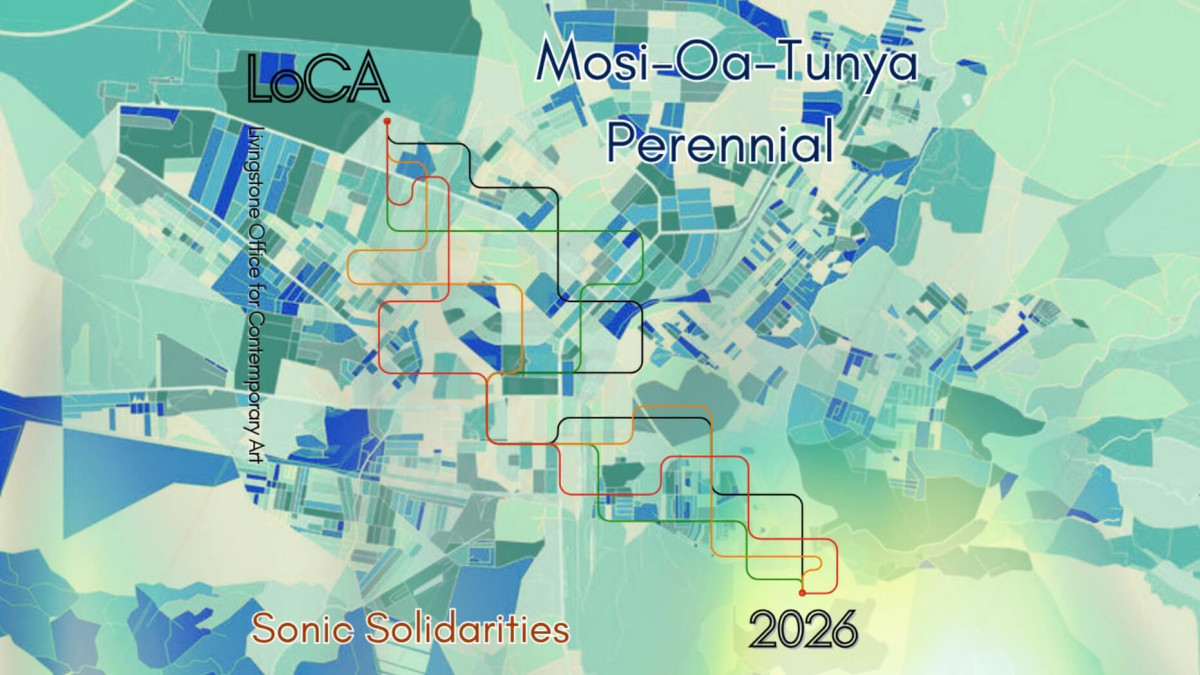
From Johannesburg to Zambia. The Zambian leg, led by one of the WITS PhD students, Lineo Segoete, and designed under the leadership of Anawana Haloba, the co-founder of LoCA, is scheduled to coincide with the opening of the Zambia Perennial, hosted by the Livingstone Office for Contemporary Art (LoCA). This is an important extension of the Johannesburg symposium to the Livingstone Perennial, as it is not just a showcase of the work of our students; it is a gesture of solidarity that also begins to map the diverse modes of curatorial practice on the continent beyond known cultural terrains. This event launches new ways of thinking about mega art exhibitions in the African context. Instead of calling itself a Biennale, the Perennial is conceptualised around the infrastructure alternatives in our geographical region, which defy regulatory borders and immigration laws. Perenniality in this instance is a mode or method in which the sustainability of resources, economy and agency occurs. It is thought of as a process that allows rejuvenation within itself in that when something is running out, overused or outrun, it resuscitates itself or finds a way to adapt by necessity. The collaboration between the Wits, the Curatorial Public and Visual Cultures department, and LoCA is designed as a response and an intellectual offering to this curatorial emergence. As one of the few schools in South Africa that offers formal training in curatorial practice, this conversation with the Zambian context is critical.
Keynotes
Dr. Uhuru Phalafala is a writer, cultural historian, researcher, and archivist with research interests in critical race studies, anti-colonial social movements, indigenous epistemologies and cosmologies, and jazz. Her work draws from a historical wellspring of Black spiritual and creative intelligence, harnessing the dream-building energies of Black Atlantic expressive cultures and feminist creative ingenuity firmly rooted/routed in local African (diasporic) wisdoms of spirit and soil. She is a Senior Lecturer in Literary Studies at Stellenbosch University, and the author of Mine Mine Mine (2023) and Keorapetse Kgositsile & the Black Arts Movement: Poetics of Possibility (2024).
Professor kąrî’kąchä seid’ou is an artist-intellectual, poet, teacher, mathematician, and associate professor of modern and contemporary African Art in the Department of Painting and Sculpture at the Kwame Nkrumah University of Technology (KNUST). Recognized as Ghana’s leading figure in non-proprietary art, he conceived and implemented the “Emancipatory Art Teaching Project”, which fundamentally transformed the fine art curriculum at KNUST. He co-founded blaxTARLINES, an open-source and community-driven art collective inspired by his art practice and emancipatory pedagogy. His mentees and protégés flourish as artists, curators, scholars, and cultural professionals, forming the core of Ghana’s Contemporary and Post-Contemporary art waves. Although deeply influential, he chooses to work with quiet discretion.
Anawana Haloba was born in Livingstone, Zambia, and lives and works in Oslo and Livingstone. She is one of the founders of the Livingstone Office for Contemporary Arts (LoCA), which is currently working on the “Mosi Oa Tunya Perennial”, a large-scale international exhibition to be presented in Livingstone, Zambia. Haloba was educated at the Evelyn Hone College of Applied Arts in Lusaka, Zambia, and completed her bachelor’s degree at the National Academy of Fine Arts in Oslo in 2006. She furthered her education at the Rijksakademie van Beeldende Kunsten in Amsterdam, the Netherlands. Besides her extensive artistic practice, she is an Associate Professor of Contemporary Art, specialising in decolonial theory in artistic practice, at the Oslo National Academy of the Arts, and a guest advisor at the Rijksakademie.
Curatorial Internationalism After the Global
This roundtable convened by Prof. Mick Wilson (CAPIm) with colleagues from the EARN Curatorial Studies Workshop includimg Cătălin Gheorghe, George Enescu National University of the Arts, Iași, Nina Liebenberg, (Academy of Fine Arts, UniArts Helsinki), Nontobeko Ntombela, (WITS Johannesburg) and Andris Brinkmanis, (NABA, Milan) addresses the question of how international imaginaries and material conditions shape the politics of exchange.
Over the last decade, there has been a lively engagement across several disciplines with the dynamics and stakes of various cultural internationalisms. These internationalisms have been constituted through diverse political projects ranging from Pan-Africanism to the Non-Aligned Movement; from Transatlantic Abolitionism to Islamic feminist internationalism; and from Imaobong Umoren’s “Race women’s internationalism” to Via Campesina’s peasant internationalism. These questions of internationalisms – emphatically plural – are newly reactivated, not only in academic and policy discourse, but also within artistic and curatorial practice. Projects such as Chimurenga’s extensive work on FESTAC ’77 (2014-2019); Mey and Pirotte’s Spectres of Bandung: A Political Imagination of Asia-Africa (2023); and the Staatliche Kunstsammlungen Dresden’s ambitious exhibition series Sequences: Entangled Internationalisms (2024) indicate the wide currency of internationalism as a problematic engaged within artistic practice. Some commentators cite the apparent demise of globalisation—the paradigm of international relations provided by neoliberalism and finance capital—as one of the conditions of emergence for this renewed focus on internationalism otherwise. While others point to the role of the international art system itself as a symptom and a conduit of neoliberal globalisation. For some, the continuities of extractivism, epistemic violence and intensified neocolonial relations seem unaltered even as decolonization and indigeneity become themselves commoditised terms within global minority dominated cultural discourses. Others cite the centuries long traditions of resistance to colonialism and imperialism and propose radically different histories and perspectives on internationalism. Against this backdrop, this roundtable considers the potentials and challenges of international collaboration and networking within curatorial production, practice and study. What are the potentials, limitations and pitfalls of international collaborations and exchanges in contemporary artistic and curatorial practice, education and research? What is the potential emancipatory role of “regional internationalisms”? What are the tools and concepts with which to consider different projects and programmes of internationalism? In a context of rising inequality, authoritarianism and xenophobia, are there operations of international exchange and encounter that can enact open and non-reductive imaginaries of “here” and “elsewhere”? What examples and visions for emancipatory internationalism are being overlooked or misrecognised?