The Contested Doctorate (2025-2028)
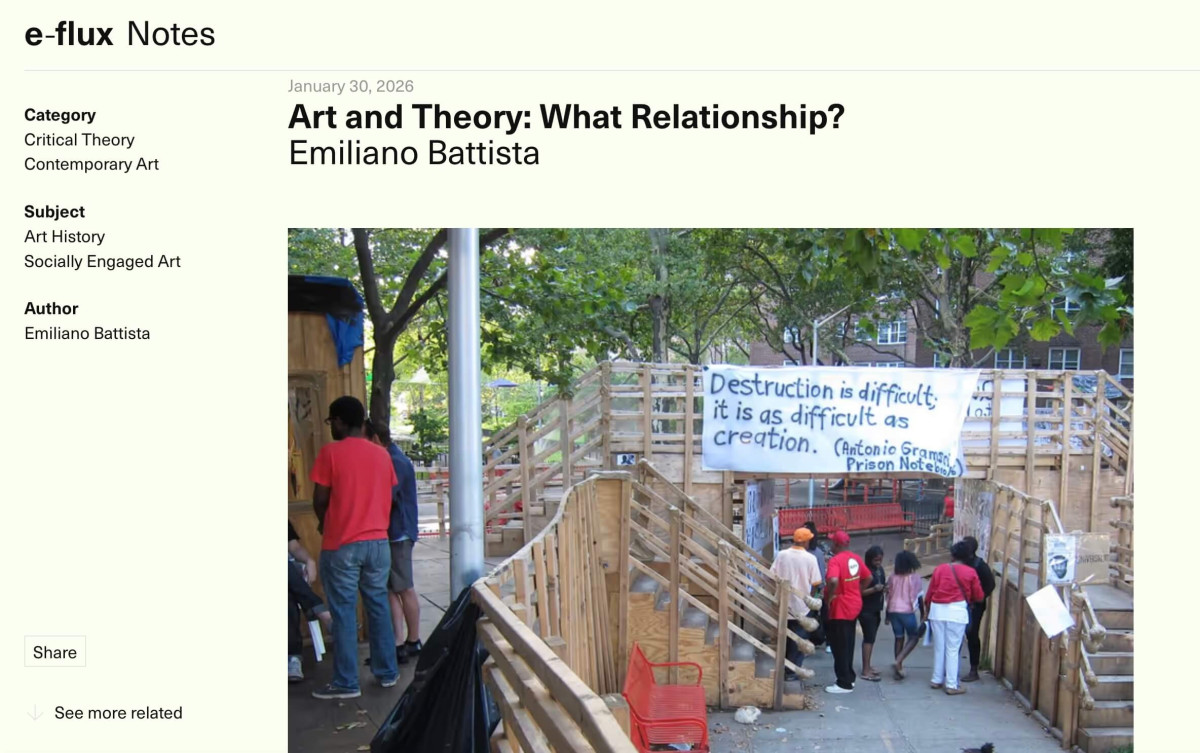
Battista’s contribution to the June 2025 issue of e-flux journal addressing how questions of theory and art are approached, advocating for the study of concrete instances rather than general pronouncements.
Emiliano Battista
This associated project is a bi-national comparative study of educational practices and experiences in 3rd Cycle artistic research training that is jointly realized by Vrije Universiteit Brussel (VUB) and Gothenburg University (GU). The goal of this project is to provide systematic and reliable information about, and insight into, the actual practices and experiences of PhD holders, candidates, and supervisors of 3rd cycle programs in the arts. The project has been initiated by Prof. Walter Ysebaert (VUB) and Prof. Mick Wilson (HDK-Valand) and the doctoral researcher is Emiliano Battista.
Battista has initiated the research by compiling a detailed dataset of artistic doctoral work completed since these awards emerged at the beginning of the 21st century in both national contexts. He has also been publishing in the general area of his research interest, particularly his focus on the relations and gaps between theorists addressing the general conditions of artistic research and the actual experience and knowledge of doing artistic research. In an early stage of the process, Battista has said in an internal resport that: “This entire project is born from the observation that the sizeable and growing literature about the arts PhD has by and large ignored not only the work done by artist-researchers as part of their doctorate but also the rationales—if any are given, which is not always the case—offered by their makers.” He goes on to note that:
Very little is known about what has been done and said, and the aim of the exercise is to shed light on those things. As such, it is descriptive and not normative: it identifies and describes traits, and in so doing makes it possible for us to see, concretely, where “practice-based research” overlaps with “traditional” forms of academic research, and where it does not. Is there a research question? A methodology? A review of the state of the art and an articulation of the research context? The recourse to these and similar questions as initial guides to the mapping is not aimed at making academic research the norm against which we measure and evaluate artistic research, but a foil that can allow us to understand what is unique and distinctive—if anything—about research in this context.
Among Battista’s recent publications are his polemical short text, “Art and Theory: What Relationship?” in the June 2025 issue of e-flux journal which argues for greater attention to concrete instances of relation rather than general pronouncements: “to move away from the abstractions—Art and Theory—that have governed the discussion in order to focus on specific instances, to look closely at how art-world agents (artist and curators) take up, deploy, read, misread, distort, or commodify concepts.” Another text, published in Autumn 2025, is a study on “Jacques Rancière and the Educational Turn: A Case Study of the Relationship between the Contemporary Art World and Theory” which appeared in the Journal of Aesthetic Education, 59 (3): 34–56. In this piece he continues his focus on the rekations between specific philosophical and theoretical sources and their role in artistic processes with the intention to shiw that “the idea that art-world actors relied on Rancière as they worked to make education the ‘form and content of curatorial and artistic projects’ is plagued by historical and conceptual difficulties.” In this text he attempts to provide “a way out of the tendency to treat the art world’s relationship to theory as a block rather than as a set of individuated relationships.”
As an aspect of the research process, the team collaborated with colleagues in several other institutions—the Vrije Universiteit Brussel; Koninklijk Conservatorium Brussel; RITCS School of Arts; the University of Gothenburg; the University of Stellenbosch; and the University of Warwick—to organise a two-day conference in Brussels “From Experience: The Arts PhD in Practice” 5-6 March 2026. The concern was to open a discussion about the actual experience of doctoral studies in the arts rather than rhetorical claims about art and research in general.
Another of the research developments that has emerged from his work on mapping the artistic doctorate is a new inter-institutional initiative between VUB Brussels, Belgium and HDK-Valand, Gothenburg, Sweden, as a CAPIm associated initiative to develop the Observatory of the Artistic Doctorate. Building on his dataset from the Swedish and Belgian contexts, we are developing a systematic basis for tracking the development and transformations of the artistic doctorate globally. This is an inter-institutional initiative developed in partnership with colleagues from NABA Milan, Italy; University of the Arts Bremen, Germany; and Georges Enescu National University of the Arts, Iași, Romania, and a growing international network of colleagues.